



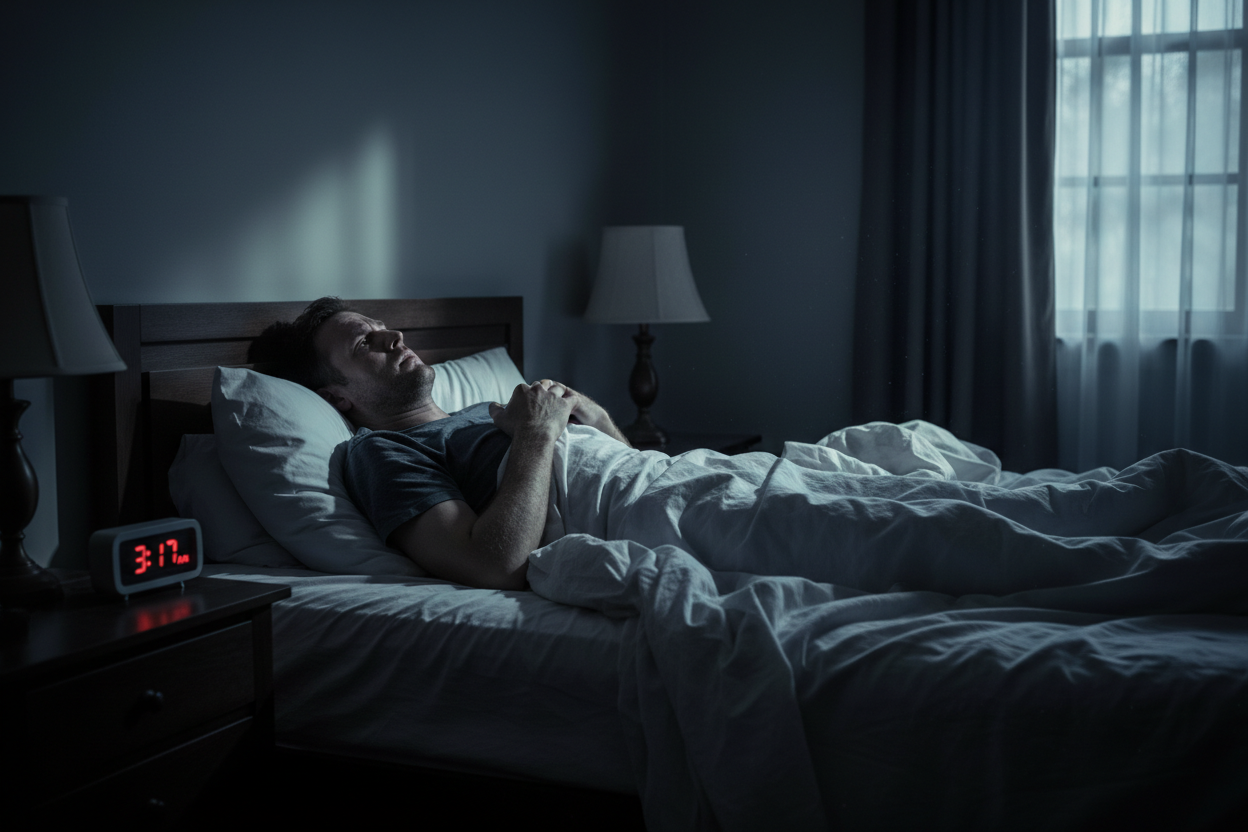
I used to lie in bed at night with a perfectly ordinary to-do list running on a loop — things I forgot to say, conversations I was still rehearsing, things I needed to do tomorrow. The house would be quiet, I'd be genuinely exhausted, and yet my brain absolutely refused to stand down. If that sounds familiar, you're not alone — not even close.
According to the 2025 Healthy Ireland Survey, 49% of people in Ireland wake up feeling tired almost every day, placing us in the top five globally for sleep trouble. For many of those people, the issue isn't that they can't get into bed — it's that their mind won't let them actually rest once they're there.
Why does your mind race when you finally get into bed?
Your brain suppresses background anxiety during the day by keeping itself busy — tasks, conversations, screens, noise. The moment you lie down in a quiet room with nothing left to do, it switches into processing mode and starts working through everything it's been holding. Researchers call this cognitive intrusion: your brain trying to clear its inbox at the worst possible time.
There's also a stress hormone piece that doesn't get talked about enough. Cortisol — your main alertness and stress hormone — should follow a natural rhythm: high in the morning, steadily declining through the day, and reaching its lowest point at night. But when you're chronically stressed, over-stimulated, or skipping proper wind-down time, cortisol doesn't drop the way it should. It stays elevated. And elevated cortisol at night keeps your nervous system in a low-level fight-or-flight state — scanning for threats, flagging things as urgent — which is the complete opposite of the physiological calm your brain needs to drift off. I go into more detail on this in my piece on the connection between cortisol and sleep if you want to read further.
What's actually happening in your brain when you can't switch off?
When your mind races at bedtime, your brain is, in simple terms, too loud. The neurotransmitter system that should be quietening neural activity — primarily GABA (gamma-aminobutyric acid) — is being outcompeted by excitatory signals. Think of GABA as your brain's natural volume dial; racing thoughts happen when that dial is stuck on high.
Norepinephrine is the chemical most closely linked to hyperalertness — the state where your brain flags everything as important and can't let anything go. EEG studies show that people with night-time intrusive thoughts tend to have lower alpha brainwave activity. Alpha waves are what you generate when you're in a state of relaxed, calm awareness — the mental place you're in after a good meditation, or in the moments before you naturally drift off. In people with racing thoughts, that calm baseline is harder to reach, especially in the hour before sleep.
Understanding the mechanism matters because it tells you exactly where to intervene.
Can supplements actually help with an overactive mind at night?
Yes — and I want to be specific here, because vague advice about “taking something for sleep” has never helped anyone.
The ingredient with the strongest research for an overactive mind at night is L-Theanine, an amino acid found naturally in green tea. A 2025 meta-analysis published in Sleep Medicine Reviews — pooling data from 19 randomised controlled trials and nearly 900 participants — found that L-Theanine significantly improved sleep onset latency (how long it takes to fall asleep), daytime functioning, and overall sleep quality scores. What makes it particularly relevant for racing thoughts is the mechanism: L-Theanine raises GABA and serotonin, lowers norepinephrine (the hyperalertness chemical), and increases alpha brainwave activity. It nudges your brain toward that calm, meditative state — without sedation. You can take it and still function if you need to; it doesn't knock you out.
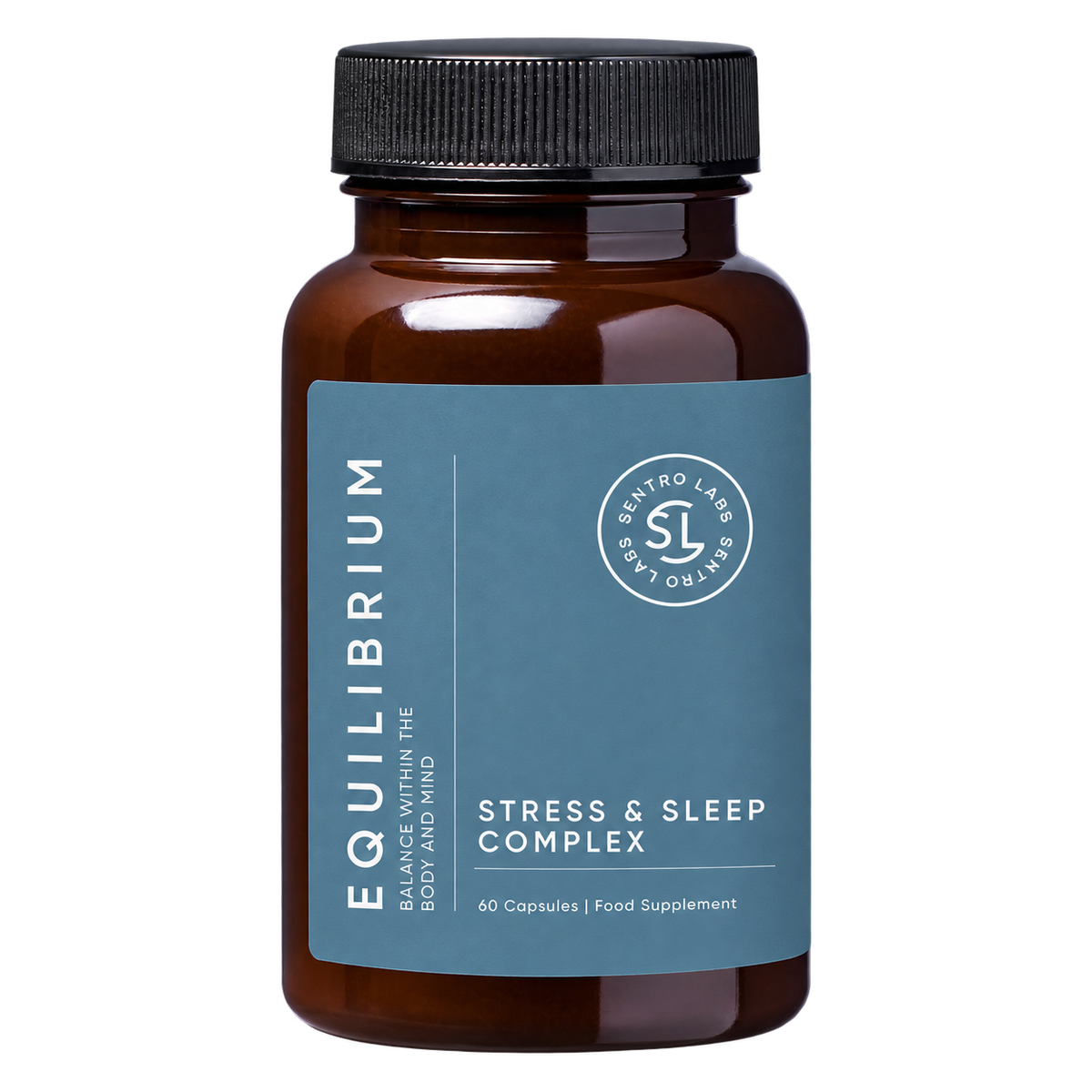
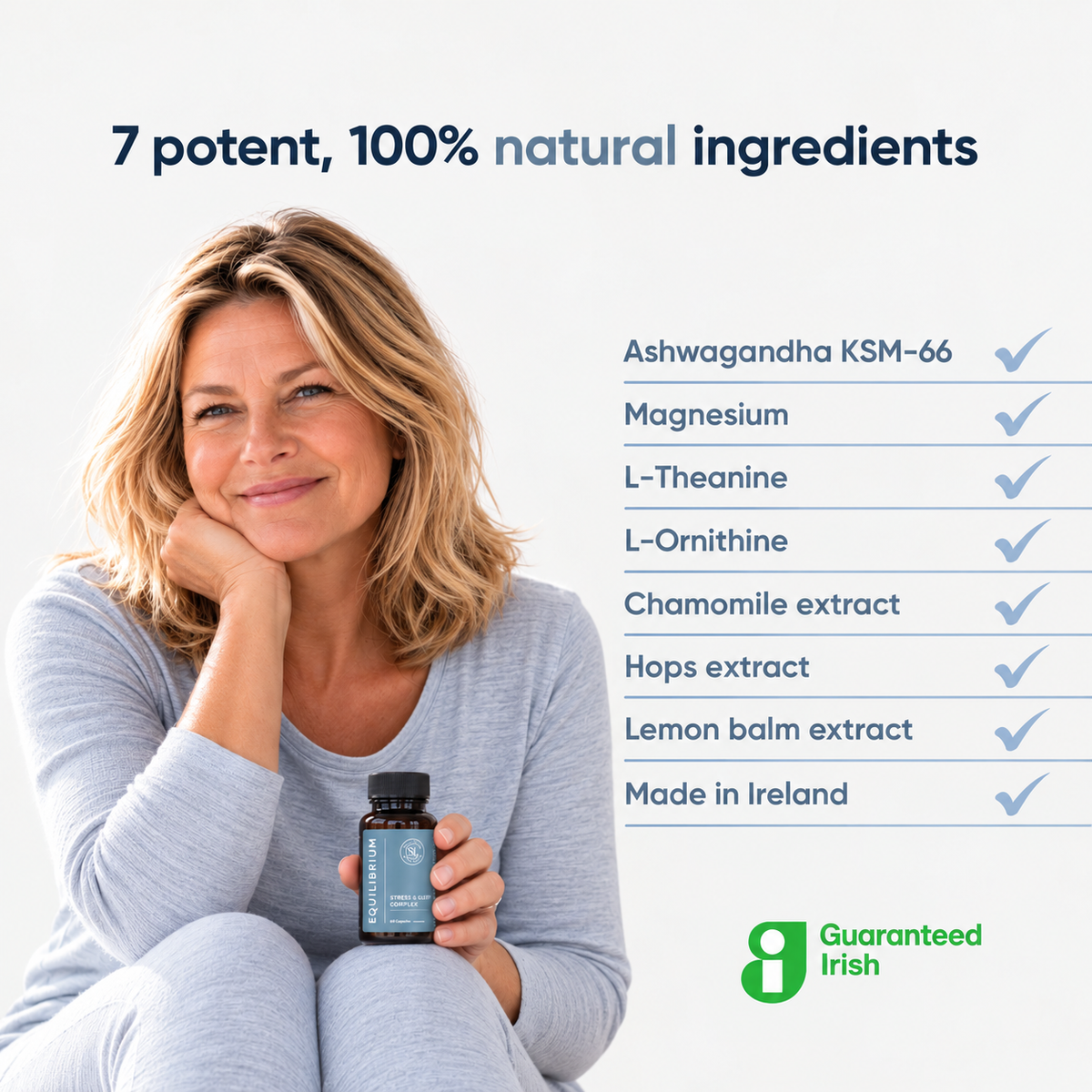
This is exactly why I included L-Theanine in Equilibrium — my Stress and Sleep Complex. The dose matters: the research consistently uses 200–400mg. Equilibrium contains 200mg of L-Theanine alongside Ashwagandha KSM-66 (to help regulate the cortisol patterns that fuel racing thoughts in the first place) and Magnesium Glycinate (for nervous system calm). When I was going through my own worst patch of sleeplessness, I found it wasn't one ingredient that made the difference — it was addressing the stress-cortisol-sleep cycle together, from multiple angles.
Magnesium Glycinate is worth understanding on its own terms, too. Magnesium acts as a natural NMDA receptor antagonist — it dampens overactivation of excitatory pathways in the brain. Low magnesium is associated with increased anxiety and more disrupted sleep, and many Irish adults are quietly deficient due to a diet that's low in leafy greens and high in processed food. Our standalone Magnesium Bisglycinate is a good option if you want to try that on its own first.
What practical steps can actually help you calm down before bed?
Supplements work best as part of a broader approach. Here's what the evidence actually supports — not generic wellness advice, but things with real mechanistic grounding:
- Write tomorrow's list before you try to sleep. A study in the Journal of Experimental Psychology found that writing a specific to-do list for the following day — not journalling about the past — significantly reduced intrusive thoughts at bedtime and helped people fall asleep faster. The act of writing down what needs to be done offloads your brain's holding function.
- Dim screens an hour before bed — and choose your content carefully. Blue light suppresses melatonin, but the bigger issue is that news, social media, and reactive content keep your brain in alert, stimulated mode right up until you try to switch off. The content matters as much as the light.
- Try box breathing. Four seconds in, four seconds hold, four seconds out, four seconds hold. This directly activates your parasympathetic nervous system — your rest and digest mode — counteracting the cortisol-driven alertness that's keeping you awake. Two minutes is enough to shift your baseline.
- Keep a consistent wake time. More than your bedtime, your wake time anchors your circadian rhythm. Even after a poor night, getting up at the same time preserves your sleep pressure (adenosine buildup) for the following evening. It's one of the most evidence-backed sleep habits there is.
- Keep your bedroom for sleep only. Your brain learns by association. If you regularly work, scroll, or eat in bed, your brain stops registering the bedroom as a sleep cue. Re-associating the space takes two to three weeks of consistency, but the effect is real and lasting.
Frequently Asked Questions
Why do I get racing thoughts only at night and not during the day?
During the day, your brain is occupied — tasks, conversations, and stimulation effectively suppress background anxiety. At night, with no distractions, your brain switches to processing mode and starts working through what it has been holding. This is a normal function, not a sign that something is wrong with you. The goal is to give your brain a structured way to offload before you get into bed — like writing a tomorrow list — rather than doing the processing in the dark.
Is L-Theanine safe to take every night for sleep?
L-Theanine is considered safe for daily use. It is an amino acid found naturally in green tea, it is non-sedating, and it does not create dependency or morning grogginess. The 2025 systematic review published in Sleep Medicine Reviews found it well-tolerated across trials of up to 28 days. As with any supplement, it is worth speaking to your GP if you have underlying health conditions or take medication.
How long does L-Theanine take to work for sleep?
L-Theanine is absorbed relatively quickly — studies show it enters the bloodstream within 30–60 minutes of taking it. Many people notice a difference in relaxation on the first night. For sustained improvements in sleep quality, consistent use over two to four weeks produces the most reliable results based on available research.
What is the best type of magnesium for sleep and anxiety?
Magnesium Bisglycinate (also called Magnesium Glycinate) is the form most supported by research for sleep and anxiety. It has high bioavailability and is gentle on the digestive system. Magnesium Oxide is poorly absorbed and largely ineffective for these purposes. For sleep specifically, always check the label for Glycinate or Bisglycinate.
Can stress cause insomnia, or does insomnia cause stress?
Both — and they reinforce each other in a cycle. Chronic stress raises cortisol, which disrupts sleep. Poor sleep raises cortisol, which worsens your stress response the following day. Breaking the cycle usually requires addressing both sides: supporting your stress response during the day and supporting calm at night through the right combination of lifestyle habits and targeted nutrients.
If racing thoughts have become your normal before bed, I want you to know it's not a personality trait or something you're stuck with. It's a nervous system that hasn't been given the right conditions to downshift — and that's something you can genuinely work on.
I built Equilibrium because I needed it myself. A formula that helps regulate stress during the day so the nights start to look after themselves. If an overactive mind is your main barrier to sleep, it's where I'd start.
This article is for informational purposes only and does not constitute medical advice. Please consult your GP if you are experiencing persistent sleep difficulties.
Explore our sleep support range:
- Equilibrium — Stress & Sleep Complex (Ashwagandha KSM-66, L-Theanine 200mg, Magnesium Glycinate, Active B-Complex)
- Magnesium Bisglycinate — Sleep & Nervous System Support
















Share:
What I Wish Someone Had Told Me About Perimenopause
Quick and Easy High-Protein Lunch for Women in Meno & Perimenopause