




A note from Robert & Elaine on the stress–sleep loop — and what finally helped us break it.
If you're over 40 and you've ever lain in bed at 3am with a brain that refuses to switch off, this one's for you.
Same. We've been there. Running a business, raising a family, trying to stay in decent shape, trying to eat well, trying to sleep properly — and finding that the harder we pushed, the worse the sleep got. Wired but exhausted. Asleep by 11, awake at 3.30 with the jaw clenched and a brain that won't stop.
That loop has a name. And once you understand it, a lot of the "sleep hacks" stop feeling useful — and a couple of things start to matter a lot more.
The stress–sleep loop, in plain English
Here's the short version. When your nervous system is running hot during the day — deadlines, emails, parenting, hormones, life — your body produces cortisol to keep you going. Cortisol is useful. It gets you out of bed in the morning and helps you handle pressure.
The problem is when it doesn't come back down.
Cortisol is supposed to peak in the morning and fall through the day, letting melatonin rise so you can sleep. If you're stuck in "always on" mode, that curve flattens. Cortisol stays high into the evening. You go to bed shattered, but your body is still running on the wrong hormone. You either can't fall asleep, or you wake at 3am with your heart racing for no obvious reason.
We wrote a longer piece on this here: how cortisol quietly wrecks your sleep. If you've been blaming caffeine or your phone and nothing's really improving, read that one next.
The short answer: you can't "sleep harder" to fix this. You have to bring the cortisol curve back to something like normal. That means managing stress during the day — not just trying to force sleep at night.
Why ashwagandha kept coming up
We didn't set out to make a supplement brand on a trend. Elaine had been reading around perimenopause and stress — the two are tangled up in ways nobody prepares women for — and ashwagandha kept showing up. Not in wellness TikTok. In the actual research.
Ashwagandha is an Ayurvedic herb that's been used for thousands of years, but the interesting part is that modern studies have started to confirm what traditional practitioners always claimed. The mechanism most relevant to you, if you're reading this at 3am, is cortisol regulation.
In controlled human trials, ashwagandha supplementation over 8–12 weeks has been shown to meaningfully reduce cortisol levels in chronically stressed adults. It's classed as an adaptogen, which means it helps your body adapt to stress rather than just masking the symptoms. In practice, that translates to a calmer daytime nervous system, which translates to a cortisol curve that actually drops when it's supposed to, which translates to deeper sleep.
It's not a sedative. You don't take it and fall over. It works upstream — on the stress response — and the better sleep comes as a consequence. That's an important distinction. Most "sleep supplements" try to knock you out. Ashwagandha fixes the reason you couldn't sleep in the first place.
For women navigating perimenopause, there's a further angle worth knowing: ashwagandha has been studied specifically in that context, and there's reasonable evidence for benefits on mood, sleep quality and hormonal balance. We wrote about that here: can KSM-66 ashwagandha help through menopause and perimenopause?
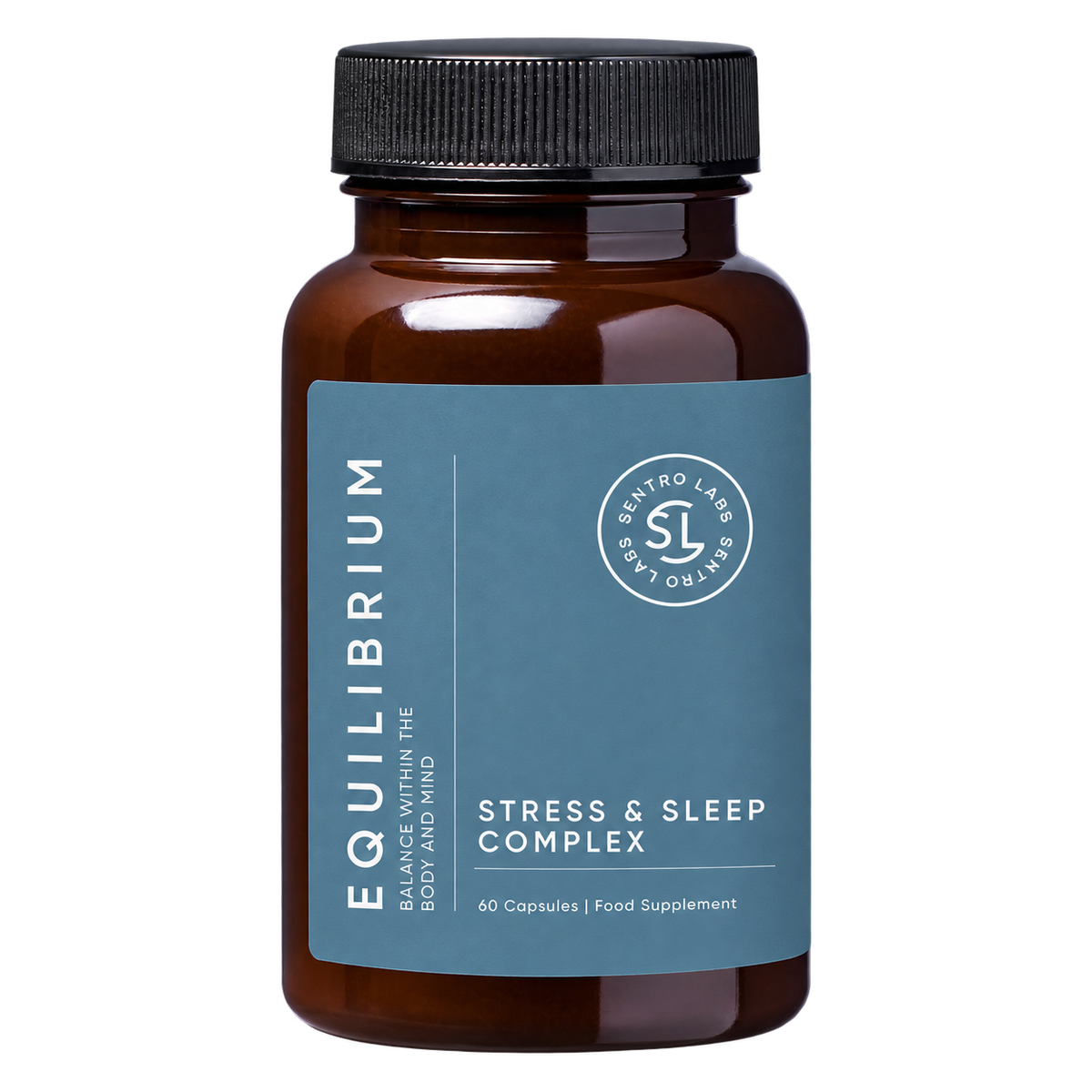
What we put in Equilibrium (and why)
When we started formulating Equilibrium, we had one rule: use the version of ashwagandha that's actually been tested, at a dose that matches the research.
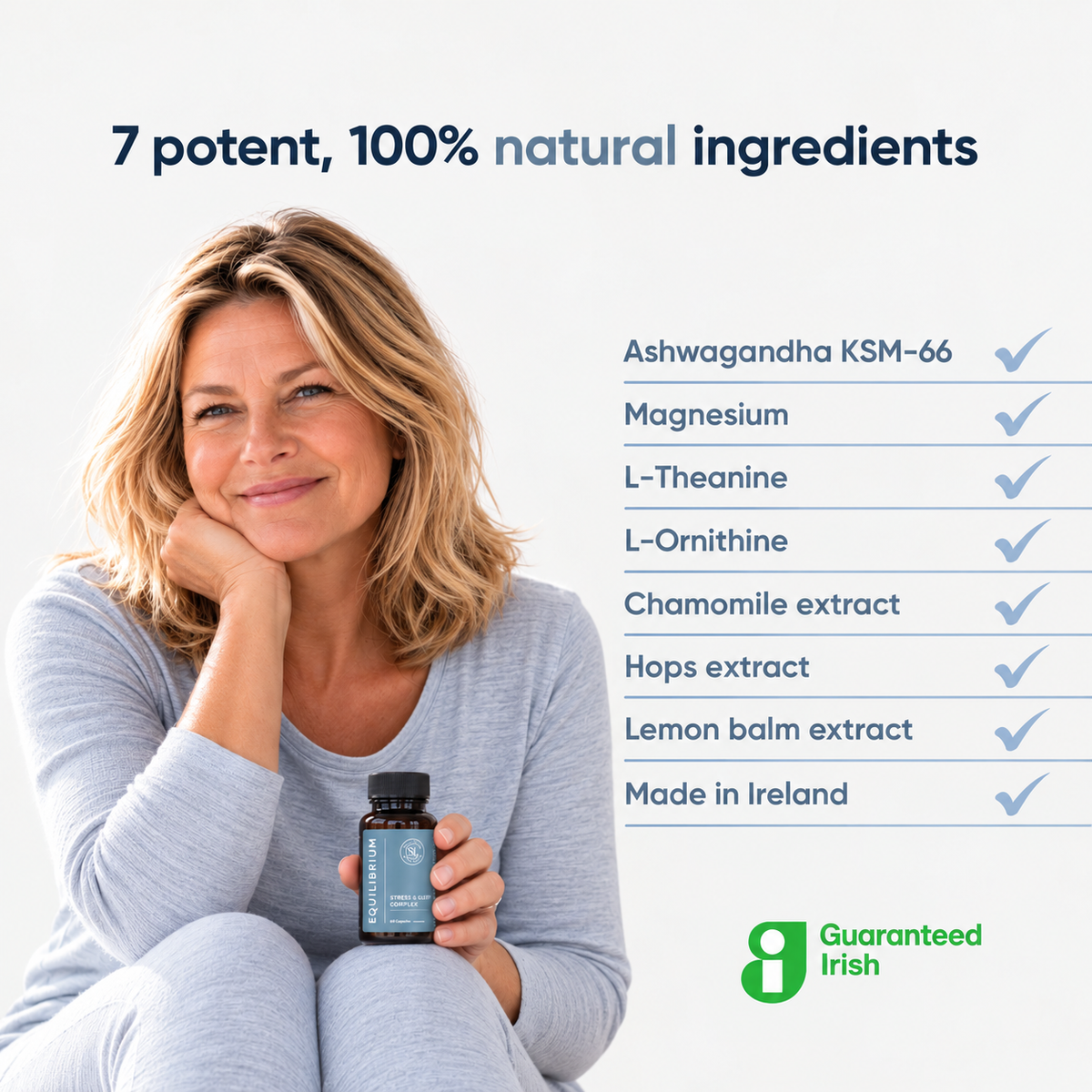
That meant KSM-66. It's a branded, standardised root extract, and it's the one most of the published human trials use. A lot of the cheaper ashwagandha on the market is unstandardised, uses the leaf as well as the root, or is dosed at levels that wouldn't have moved the needle in any clinical trial.
Equilibrium gives you the full clinically studied dose of KSM-66 in two capsules a day. No filler-heavy formulas. No stimulants. No "complex" of twelve adaptogens at sub-therapeutic doses designed to look impressive on the label. Just the thing that has the evidence, dosed properly, every day.
Pair it with magnesium. Seriously.
If ashwagandha is the daytime tool — bringing the cortisol curve back to normal — magnesium is the nighttime tool. It's one of the most common deficiencies in adults over 40, and it's directly involved in the nervous system pathways that let your body actually wind down at night.
We consider that pairing the core of any real sleep protocol. If you only read one other thing after this, make it our pillar piece: magnesium for sleep.
And if you've already tried "magnesium" from the supermarket and it didn't do much — there's a reason for that. Different forms of magnesium behave very differently in the body. The cheap stuff in most multivitamins is poorly absorbed. The forms that actually help with sleep are specific. We broke that down here: which magnesium is best for sleep.
Ashwagandha during the day. The right magnesium in the evening. Consistent bedtime, fewer screens. That's the stack. Everything else is noise.
An honest word on timelines
This isn't a sleeping pill. Don't expect night one.
In our experience, and in the studies, the window where things start to shift is 2–4 weeks. By 8 weeks, if it's going to work for you, the difference is obvious — less edge during the day, fewer 3am wake-ups, a body that actually feels tired at bedtime the way it's supposed to.
If you take it for two nights, notice nothing, and stop — you'll miss the effect. That's not us selling you a longer course. That's just how the mechanism works. You're re-regulating a daily rhythm, not sedating a nervous system.
A couple of honest caveats
Ashwagandha isn't for everyone. If you're pregnant, breastfeeding, on thyroid medication, or managing an autoimmune condition, talk to your doctor before starting. Same goes if you're on any sedative medication. We'd rather you check than guess.
Our take
We make Equilibrium because we take it. Both of us. Every day. It's not a miracle — nothing in a capsule is — but it's one of the few things that earned its place in our routine by actually changing how we feel.
If you've been stuck in the tired-but-wired loop and nothing's moved the needle, it's worth eight weeks of your time.
— Robert & Elaine Founders, Sentro Labs










Share:
What's the Connection Between Cortisol and Sleep?
The Link Between Stress and Poor Sleep (and How to Fix It)